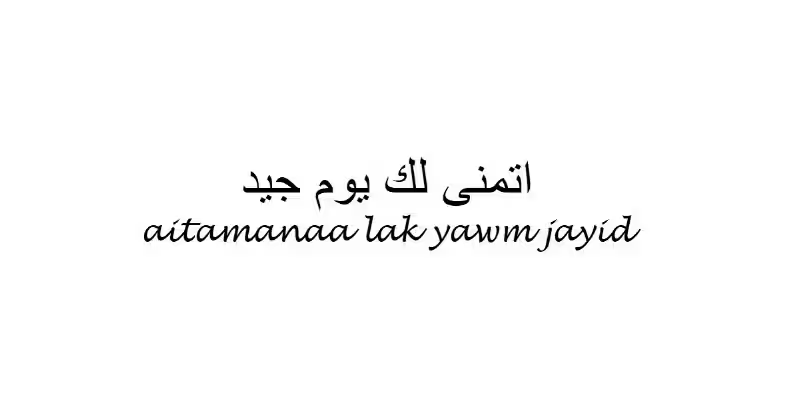
How to Say “Have a Good Day” in Arabic: A Guide to Expressing Positivity
Learning how to say “Have a good day” in Arabic is a simple yet powerful way to connect with people from Arabic-speaking cultures. It’s a gesture of kindness and respect, demonstrating your awareness and appreciation of their language and traditions. Whether you’re traveling, interacting with Arabic-speaking colleagues, or simply want to expand your linguistic repertoire, mastering this phrase can open doors to meaningful interactions.
Arabic, like many languages, offers a variety of ways to express “Have a good day,” each with its own nuance and context. Here are some of the most common phrases:
1. “Yawm Sa’eed” (يوم سعيد)
This phrase stands as the most direct and literal translation of “Happy Day.” It’s widely understood and commonly used across the Arabic-speaking world. It’s a simple and straightforward way to express your hope for a positive day for the person you’re addressing.
2. “As-Salam Alaykum Wa Rahmatullahi Wa Barakatuhu” (السلام عليكم ورحمة الله وبركاته)
This is a traditional Arabic greeting that translates to “Peace be upon you, and the mercy of God and His blessings.” While not a direct equivalent of “Have a good day,” it conveys a similar sentiment of wishing someone well and wishing them peace and blessings. It’s often used as a general greeting, particularly in formal settings or among Muslims.
3. “In Shaa Allah” (إن شاء الله)
This phrase literally means “If God wills” and expresses hope for a positive outcome. It’s commonly used after wishing someone a good day, adding a layer of optimism and faith. It’s a versatile phrase that can be used in various situations.
4. “Ma’a As-Salāma” (مع السلامة)
This translates to “With peace” and serves as a farewell phrase. While not explicitly wishing someone a good day, it conveys the sentiment of parting on a positive note. It’s often used at the end of a conversation or interaction.
While these phrases provide a good starting point, understanding the context and cultural nuances is crucial. Here are some tips to ensure you use these phrases effectively:
1. Consider the Context
The appropriate phrase depends on the situation and the person you’re speaking to. For instance, “Yawm Sa’eed” is suitable for casual interactions, while “As-Salam Alaykum” is more formal.
2. Pay Attention to Tone
Your tone of voice plays a significant role in conveying sincerity and warmth. A friendly tone and a smile can enhance the impact of any greeting.
3. Be Mindful of Cultural Differences
Remember that there may be regional variations in how these phrases are used. It’s always advisable to err on the side of caution and choose a more general greeting if you’re unsure about the appropriateness of a particular phrase.
More than Words: The Importance of Cultural Sensitivity
Learning how to say “Have a good day” in Arabic is just the beginning. It’s essential to remember that language is just one aspect of cultural understanding. Being mindful of cultural differences, respecting customs and traditions, and approaching interactions with genuine curiosity and empathy can foster deeper connections and build stronger relationships.
By taking the time to learn and practice these simple phrases, you’re not just learning a language; you’re engaging with a rich culture and demonstrating your desire to connect with people on a deeper level. It’s a small gesture that can have a big impact, bringing smiles and warmth to your interactions with Arabic speakers.
How to Say “Have a Good Day” in Arabic
What is the most common way to say “Have a good day” in Arabic?
“Yawm Sa’eed” (يوم سعيد) meaning “Happy Day” is the most common and literal translation.
Yes, “As-Salam Alaykum Wa Rahmatullahi Wa Barakatuhu” (السلام عليكم ورحمة الله وبركاته), meaning “Peace be upon you, and the mercy of God and His blessings” is a traditional Arabic greeting that conveys a similar sentiment.
What about “In Shaa Allah”?
“In Shaa Allah” (إن شاء الله), meaning “If God wills,” expresses hope for a good day and is often used after wishing someone a good day.
Is “Ma’a As-Salāma” a good option?
“Ma’a As-Salāma” (مع السلامة) translates to “With peace” and is a farewell phrase that can be used to express hope for a good day.
How do I pronounce these phrases?
“Yawm Sa’eed” (يوم سعيد): “yow-m sa-ee-d”
“As-Salam Alaykum Wa Rahmatullahi Wa Barakatuhu” (السلام عليكم ورحمة الله وبركاته): “as-sa-laam a-lay-kum wa rah-ma-tu-lla-hi wa ba-ra-ka-tu-hu”
“In Shaa Allah” (إن شاء الله): “in shaa al-lah”
“Ma’a As-Salāma” (مع السلامة): “ma-a as-sa-la-ma”
What are some tips for using these phrases?
Context is key: Consider the situation and the person you’re speaking to when choosing a phrase.
Tone of voice: A friendly tone of voice and a smile will enhance the sentiment.
Cultural sensitivity: Be mindful of cultural differences and avoid using phrases that might be considered inappropriate or offensive in certain contexts.
Use “أتمنى لك يومًا سعيدًا” (at-manee lak yawman sa’eedan) for a general “Have a nice day” wish.
For a more empathetic approach, use “أرجو أن يكون يومك أفضل” (ar-joo an yakoon yawmak afdal) meaning “I hope your day is better”.
Speak slowly and clearly with a warm tone and a smile.
Acknowledge you are not fluent in Arabic to show your effort to connect.
Keep it brief, a simple heartfelt expression is more impactful.
Pronounce “أتمنى لك يومًا سعيدًا” as “at-mah-nee lak yow-man sa-ee-dan”.
Pronounce “أرجو أن يكون يومك أفضل” as “ar-joo an ya-koon yow-mak af-dal”.
Your gesture, even small, can make a big difference.
Use these phrases to show empathy and understanding to your client.
These phrases are appropriate for both formal and informal settings.
The phrase “Yawm Sa’eed” (يوم سعيد) can also be used, meaning “Happy Day”.
You can also use “In Shaa Allah” (إن شاء الله) which means “If God wills” for a hopeful wish.
Be mindful of cultural differences and avoid using phrases that might be considered inappropriate.
You can ask your client if they prefer to be addressed in Arabic or English.
It’s okay to make mistakes, your effort to communicate will be appreciated.
Showing kindness and respect can build strong relationships.
Context is key, choose the phrase that best fits the situation.
A sincere “Have a nice day” can be a powerful gesture.
Your client will appreciate your effort to connect with them on a personal level.
Learning a few Arabic phrases can go a long way in building trust and rapport.
Remember that language is a bridge between cultures.
Be confident in using these phrases, even if you are not perfect.
Your willingness to learn and connect will be appreciated.
Take your time, speak slowly, and listen attentively.
Use gestures and facial expressions to enhance communication.
Be respectful of your client’s culture and traditions.
Your effort to learn Arabic shows your commitment to the relationship.
Even a small gesture of kindness can make a big difference.