Is Damma on Shadda After Mohammdurr? A Deep Dive into Arabic Pronunciation
Understanding the intricacies of Arabic pronunciation, especially when dealing with diacritical marks, can be challenging. One such mark, the shadda (ّ), is essential to grasp for accurate pronunciation and comprehension. This article aims to delve into the nuances of shadda, focusing on its application after a specific letter, and addressing the question of damma (a short vowel sound) following a shadda.
Understanding the Shadda
The shadda, a crucial diacritical mark in Arabic, effectively doubles consonants. Visually, it appears as a small “w” placed above a consonant. This doubling, or gemination, alters pronunciation, often creating a more emphatic sound compared to a single consonant. Think of the difference between “am” (عم) and “amma” (عمَّ); the doubled “m” in the latter creates a distinct and significant difference in meaning and pronunciation.
This doubling isn’t just about visual representation; it has profound implications for grammar and vocabulary. The shadda fundamentally changes how a word sounds and, consequently, its meaning. This is why mastering the rules governing its usage is crucial for fluent Arabic speakers.
Rules and Application
The shadda’s application isn’t arbitrary. Several clear rules govern its placement and use:
The Consonant Before Shadda Must Be Sakin: This means the consonant immediately preceding the shadda must not have a vowel sound associated with it. It’s a silent consonant, essentially.
The Consonant After Shadda Must Bear a Vowel: The consonant that the shadda modifies must have a vowel following it. This creates the doubling effect.
These rules ensure a clear and predictable pattern for the shadda’s implementation. Failing to follow these rules results in incorrect pronunciation and, in some cases, a change to the word’s meaning. Understanding these fundamental rules is paramount to accurate pronunciation.
Is Damma Possible After Shadda?
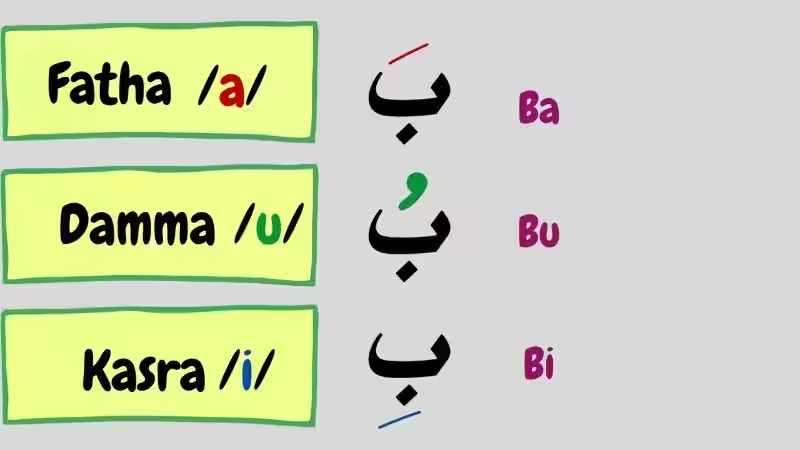
This brings us to the key question. Is a damma (a short “u” sound) possible or appropriate after the shadda? The short answer is yes, but with a crucial caveat. The placement of the damma will be determined by the rules surrounding the shadda.
The rules described above for shadda’s use still apply. The consonant immediately preceding the shadda must be sakin, and the consonant immediately after the shadda must be given a vowel. If this is the case, then the pronunciation of the damma following shadda is valid.
Shadda’s Impact on Pronunciation
The shadda affects not just pronunciation, but also the meaning of words and their grammatical roles. Consider its application in verb conjugations; the doubling can change the tense or the pronoun agreement indicated by the verb.
Furthermore, the shadda’s role in sun letters (letters that assimilate with a following laam) introduces further complexity. The doubled consonant in these instances often assimilates with the subsequent laam, modifying the pronunciation of both sounds.
The presence of shadda over the letters “n” (noon) and “m” (meem) produces a unique nasal sound known as “ghunna”. This adds another layer of acoustic nuance to the Arabic language, showcasing the complexity of shadda’s impact.
Shadda in Compound Words
The shadda isn’t confined to individual words; it plays a vital role in connecting components of compound words and phrases. When two words have identical consonants where one is sakin and the other vowel-bearing, the shadda connects them seamlessly. This helps to maintain a smooth flow and rhythm within the sentence.
Practical Application and Resources
Learning and mastering the use of shadda requires consistent practice. Online resources provide a useful platform for learning and mastering the subtleties of Arabic pronunciation. Interactive exercises can help consolidate knowledge and improve fluency.
Mastering shadda is paramount to understanding and correctly pronouncing Arabic. This diacritical mark isn’t merely a visual component; it’s deeply ingrained in the language’s pronunciation, grammar, and meaning. With dedication, consistent practice, and the right resources, anyone can successfully navigate the intricacies of shadda and unlock the rich beauty of the Arabic language. By understanding the rules, one can accurately pronounce words like “mohammdurr” with the correct application of the shadda and its corresponding damma.
Is Damma on Shadda after Mohammdurr Correct?
This FAQ addresses the use of the damma vowel mark (ضمة) following a shadda (ّ) in the context of Arabic words, specifically with the example of the word “Mohammdurr”.
Q1: What is Shadda and why is it important in Arabic?
A1: Shadda is a diacritical mark in Arabic that doubles a consonant. This doubling, or gemination, significantly impacts pronunciation and meaning, often changing the word’s meaning and grammatical function. The consonant before the shadda must be without a vowel (sakin), and the consonant after the shadda must have a vowel.
Q2: How does Shadda affect pronunciation?
A2: Shadda requires the doubled consonant to be pronounced with emphasis. This emphasis distinguishes words with doubled consonants from those with single consonants. The article provides examples demonstrating this distinction.
Q3: What are the rules for using Shadda?
A3: The consonant before the shadda must be “sakin” (without a vowel), and the consonant after the shadda must have a vowel. Shadda is never used at the beginning of a word. The article details these rules with relevant examples. The vowel after the doubled consonant (e.g., fatha, kasra, damma) affects how the shadda is pronounced and used grammatically.
Q4: Does the position of the damma after the shadda on a consonant matter?
A4: The article does not discuss the specifics of placing a damma after a shadda in the word “Mohammdurr.” It focuses on general rules of shadda usage, not on specific proper nouns. Without the complete word, and the context of the grammatical structure, it’s impossible to answer whether it’s grammatically correct.
Q5: How can I learn more about Shadda and Arabic pronunciation?
A5: The article highlights the importance of practice. Online Arabic courses and interactive exercises are recommended for mastering the intricacies of shadda. Understanding the rules and application in different grammatical contexts—verbs, nouns, and so on—are critical.
Q6: Where can I find more information about Arabic grammar and pronunciation?
A6: The article recommends online Arabic courses as a valuable resource. Further research into comprehensive Arabic grammar textbooks and online resources tailored for learners will provide additional insights into the nuances of Arabic pronunciation and grammar.
Important Note: The provided excerpt does not contain information regarding the word “Mohammdurr” or the specific placement of damma after shadda. Therefore, it’s impossible to give a definitive answer to the initial question without additional context. Any purported rule based solely on the provided fragment is speculative.