The Diacritical Mark That Indicates the Long Vowel Sound: A Guide to Pronunciation
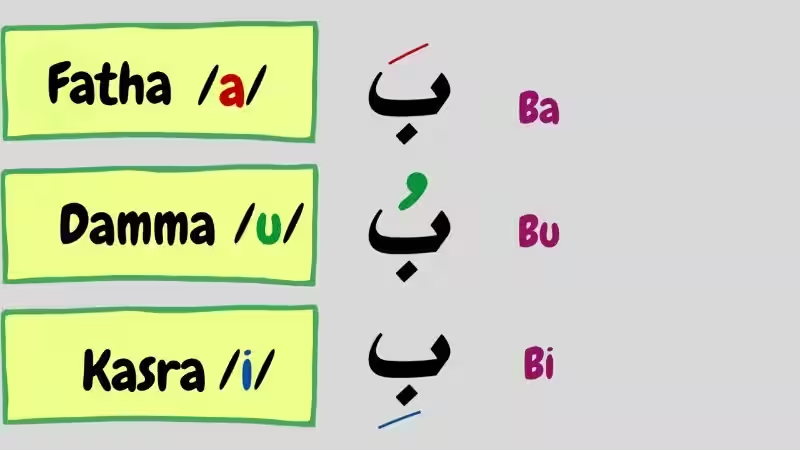
Understanding pronunciation is crucial for effective communication, whether you’re reading a complex text or speaking with someone. A vital component of accurate pronunciation is the recognition of diacritical marks. These subtle symbols, often placed above or below vowels, can significantly impact the sound of a word, and understanding them can greatly enhance your reading and speaking abilities. This article will explore the diacritical mark that indicates the long vowel sound, as well as other important diacritics.
Diacritical marks, in essence, are small symbols used to modify the pronunciation of letters. They’re not just decorative; they’re essential for accurately representing the sounds of a language. Imagine encountering a word like “bête” without the grave accent. Its meaning and pronunciation would be drastically different. The marks provide crucial information that helps us distinguish between similar-sounding words, especially in languages with multiple phonetic variations. They bridge the gap between the written form of a word and its spoken counterpart. Without these marks, pronunciation would be ambiguous, and communication could become seriously confused.
The macron, represented by a horizontal bar placed above a vowel (ā, ē, ī, ō, ū), is a fundamental diacritical mark that almost always signifies a long vowel sound. This helps you understand the difference between a short and a long vowel sound, significantly impacting how you pronounce and recognize words. Consider the words ‘pat’ and ‘pate’. The ‘a’ in ‘pat’ is short, while the ‘a’ in ‘pate’ is long, thanks to the macron. This distinction is far more than just a subtle difference; it alters the meaning and understanding of the word. This principle extends across various languages, highlighting the importance of mastering these symbols.
Often, the macron is frequently used to denote long vowels in languages like Latin, French, and English. While the English language doesn’t rely on diacritical marks as extensively as some others, their use in different forms of English (e.g., Old English, some variations of modern English) should not be overlooked. Understanding the macron’s role in these contexts can deepen your appreciation for the historical development of the language and aid in recognizing cognates or related words.
Beyond the Macron: A Tour of Other Important Diacritical Marks
While the macron is arguably the most common diacritic for indicating long vowel sounds, other marks play vital roles in indicating other nuanced pronunciations.
Acute Accent (´): This mark, often placed above a vowel, indicates stress or emphasis on a particular syllable. Its presence helps to understand where the emphasis falls in a word, which can influence the overall pronunciation.
Grave Accent (`,): Similar to the acute accent, the grave accent also indicates stress, though sometimes it signifies a different emphasis or a distinct vowel sound compared to the acute accent.
Diaeresis (¨): The diaeresis, often two dots placed above a vowel (ä, ü, ë), usually indicates that the vowels should be pronounced separately. It frequently indicates a “stretched” sound.
Circumflex Accent (ˆ): This mark, which resembles a small hat placed over a vowel, often alters the vowel’s pronunciation, sometimes lengthening it, sometimes changing its sound entirely. It can be used in many languages.
These diacritical marks, in addition to the macron, enrich our understanding of the nuances of pronunciation, making it possible to pronounce words accurately and with confidence.
Mastering Diacritical Marks: Practical Application and Resources
Learning to recognize and use diacritical marks is a valuable skill. Their importance goes beyond simply pronouncing words correctly. It improves your ability to understand written material more thoroughly in various languages, as well as improve your own writing.
Practice: Consistent practice with words containing diacritical marks is essential. Look for words with diacritics in your reading materials, and try to pronounce them correctly.
Resources: Online dictionaries like Merriam-Webster provide comprehensive lists of pronunciation symbols and examples. These resources are invaluable for learning and practicing.
Contextual Understanding: Recognizing the language or context of the text is key to understanding the correct pronunciation, as different languages employ varying conventions.
Pronunciation in Action: Listening to audio pronunciations of words with diacritics is an excellent method to internalize the sounds.
By consistently practicing and utilizing resources such as online dictionaries, you can gain a strong grasp on how diacritical marks affect pronunciation, leading to more accurate and effective communication. You will improve your vocabulary, your spelling abilities, and your overall reading comprehension.
Mastering diacritical marks, particularly the macron, is essential for accurate pronunciation and a deeper understanding of language. These seemingly small symbols hold significant weight in shaping the sounds and meanings of words. By mastering these marks, you open yourself to a broader linguistic landscape, enhancing your communication skills and expanding your intellectual horizons. With determination and practice, you can accurately pronounce a much broader range of words, opening a new level of understanding to you.
What are Diacritical Marks and Why are They Important?
Diacritical marks are symbols used in dictionaries to indicate proper pronunciation. These marks, often small symbols placed above, below, or beside letters, highlight the specific vowel sounds and nuances in pronunciation. Without understanding these marks, a word may be mispronounced, impacting comprehension and potentially even changing the intended meaning.
What Diacritical Mark Indicates a Long Vowel Sound?
The macron (ā, ē, ī, ō) is the diacritical mark most commonly used to represent a long vowel sound. A horizontal line placed above a vowel signifies that the vowel is pronounced with a longer duration than a short vowel. This distinction is crucial for accurate pronunciation and understanding of a word’s meaning.
Are There Other Marks for Vowel Sounds?
Yes, there are other diacritical marks for different vowel sounds. The diaeresis (ä, ü) indicates a stretched or modified vowel sound. While the macron indicates length, the diaeresis often signifies a change in the sound of the vowel.
Short vowel sounds are generally represented by the basic letter form without any diacritics. Conversely, long vowel sounds are typically indicated by the macron diacritic. This distinction is fundamental in grasping the correct pronunciation of words.
Beyond Length: Other Uses of Diacritical Marks
Diacritical marks are not limited to indicating long vowels. They are also used to represent various other sounds, such as schwa (ə), which represents a neutral sound. This is crucial for understanding the full range of sounds represented within a language. Additional marks specify sounds like “ng” (ŋ), “ow” (au̇), and “oy” (ȯi). The specific symbol used depends on the language and the desired sound.
How Can I Learn More About Diacritical Marks?
Merriam-Webster provides a comprehensive list of pronunciation symbols. Practicing reading words with diacritical marks will enhance pronunciation skills and speed. Understanding these marks can lead to better comprehension and enhanced vocabulary. The proper pronunciation of words is essential for effective communication.