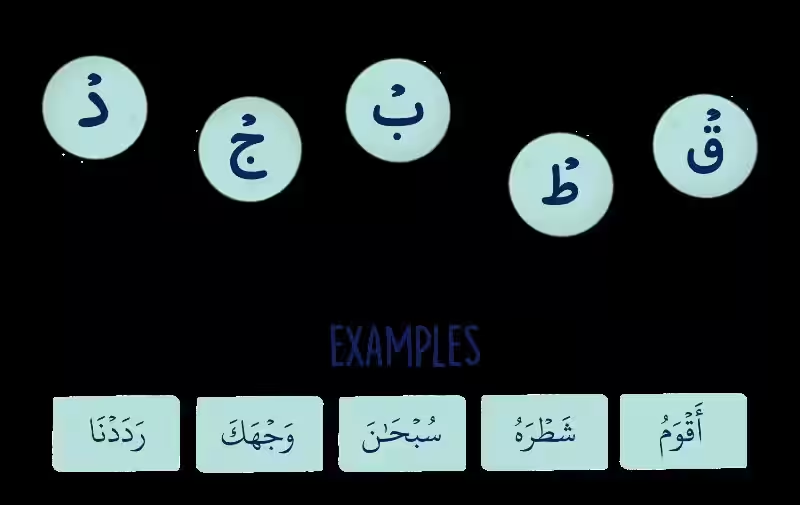
Learning Arabic can be daunting, especially when encountering unfamiliar grammatical concepts. One such concept is sukoon (سُكُون), a crucial element in Arabic pronunciation that often trips up learners. This article aims to demystify sukoon, providing a clear explanation and practical examples to help you master its use.
Understanding sukoon is essential for accurate pronunciation and comprehension in Arabic. It’s a sign of the absence of a vowel, a subtle but significant detail that drastically changes the sound of a word. Without sukoon, Arabic would lack the nuanced pronunciations that distinguish words and convey meaning. Mastering it is a step towards fluency and deeper understanding of the language.
Sukoon (سُكُون), meaning “stillness” or “rest” in Arabic, is represented by a small circle (ـْ) placed above a consonant. This small symbol signifies the absence of a vowel (harakat) above or below the letter. Imagine it as a pause – a momentary silence in the flow of sound, created by the absence of a vowel sound. This absence of a vowel sound has a profound effect on how the consonant is pronounced.
Crucially, sukoon doesn’t affect all letters in the same way. Its impact differs depending on whether it’s applied to a simple consonant or a long vowel. This distinction is key to understanding its role in Arabic pronunciation.
Sukoon and Consonants
When sukoon is placed above a consonant, it alters the pronunciation significantly. The consonant loses its inherent vowel sound, which is why it’s often described as a “silent” consonant. Consider the words “بَا” (bā) and “بَاْ” (bā’). The first word has a vowel sound, creating a distinct syllable. The second, with the sukoon, creates a different sound. The sukoon effectively removes the vowel sound, resulting in a more distinct, less vocalized sound. This illustrates the fundamental role of sukoon in shaping the flow of Arabic pronunciation.
A key distinction is how sukoon affects long vowels. When sukoon is placed on the long vowels “ا” (اَ), “ي” (يَ), and “و” (وَ), it doesn’t alter the inherent vowel sound of those letters. The sukoon doesn’t change the vowel sound on the letters. In the word “بَاي” (bay), the “ا” sound remains, despite the presence of the sukoon.
However, the application of sukoon to the long vowel “ا” itself presents a slightly more complex scenario. In this case, the “ا” with sukoon (اْ) is treated as a distinct letter, a Hamza (ء). This alteration is important to note, as it impacts the pronunciation and linguistic structure of the word. The Hamza (ء) is essentially a silent, glottal stop, which is a crucial part of the Arabic sound system.
Distinguishing Sakin and Harakat
It’s vital to distinguish between letters with sukoon (sākin سَاكِنْ) and letters with harakat (vowels). The presence or absence of these diacritical marks greatly impacts the pronunciation of words. Letters with sukoon are pronounced distinctly from those with harakat. The sukoon serves as a crucial signal to the reader or listener about the absence of a vowel sound, shaping the rhythm and flow of the spoken or written word.
Practical Application: Reading Words with Sukoon
Mastering sukoon involves a systematic approach to reading Arabic words. Follow these steps:
1. Identify the letter: Determine the consonant or long vowel.
2. Identify harakat (if present): Look for any accompanying vowel signs.
3. Identify sukoon (if present): Notice the presence or absence of the small circle.
Applying this method to words with sukoon will allow you to break down the pronunciation methodically.
Examples of Words with Sukoon
Here are some examples to illustrate the application of sukoon:
بَابْ (bāb): The “ب” (b) is followed by a fatḥa (a), and then sukoon.
قَلْبْ (qalb): The “ق” (q) is followed by a kasra (i), and then sukoon.
سَاقْ (sāq): The “س” (s) is followed by a fatḥa (a), and then sukoon.
These examples demonstrate the variety of ways sukoon can be used in different contexts within an Arabic sentence.
Diphthongs, such as “يَ” (ya) and “وَ” (wa), are combinations of a vowel sign (َ) and the letters “ي” and “و.” Crucially, when sukoon is placed on these long vowels, it does not change the inherent vowel sound of the letters. These are distinct from cases where sukoon is applied to consonants. This is because the “َ” is part of the diphthong, not a standalone vowel for the consonant.
Long Vowels vs. Diphthongs
Differentiating between long vowels and diphthongs is essential for accurate pronunciation. Long vowels, as mentioned previously, are represented by a single letter with a specific vowel sign. Diphthongs, in contrast, combine a vowel sign with another letter. This combination creates a distinct sound that differs from the individual letters. This understanding helps to avoid common pronunciation errors.
Sukoon is a fundamental component of Arabic pronunciation, signaling the absence of vowel sounds. Understanding its application, particularly its effect on consonants versus long vowels and diphthongs, is essential for mastering Arabic. By applying the practical steps and examples provided, you can confidently navigate words containing sukoon and ultimately enhance your Arabic language skills. Remember consistent practice and mindful pronunciation are key to mastering the beautiful nuances of this language. This understanding unlocks a deeper appreciation of the elegance and complexity of Arabic phonology.
What is Sukūn in Arabic?
Sukūn (سُكُون) is a crucial element in Arabic pronunciation, signifying the absence of a vowel (haraka) above or below a consonant. Imagine a consonant that is “silent” or “resting” in terms of vowel sound. It’s represented by a small circle (ـْ) placed above the consonant.
How does Sukūn affect pronunciation?
Sukūn’s impact depends on the type of letter it’s placed on. When placed on a consonant, it creates a specific sound change, essentially making the sound of the consonant without any vowel sound. For example, the word “بَا” (ba) pronounced with a short “a” sound, becomes “بَاْ” (bā’) with the sukūn, altering the pronunciation.
Unlike its effect on consonants, Sukūn placed on the long vowels “ا” (ā), “ي” (yā), and “و” (wā) does not change their inherent vowel sound. These are slightly different from the cases where Sukūn is applied to consonants, affecting their vocalization. In these cases, the letter “اْ” is treated as a separate letter, a Hamza (ء).
How are letters with Sukūn (Sakin) different from those with harakat?
Letters with Sukūn, or Sakin letters, are pronounced differently from letters with harakat (vowels). The absence of a vowel alters the way the consonant is pronounced by removing the vowel sounds. This distinction is critical for mastering the nuances of Arabic pronunciation.
How do I read words with Sukūn?
To read words with Sukūn, follow these steps: identify the letter, determine if there are any harakat (vowels), and then identify the Sukūn. This systematic approach helps in understanding the structure of the word and its pronunciation.
What is the difference between long vowels and diphthongs?
Long vowels are extended versions of the short vowels—like the “a” in “bā,” “y” in “yā,” and “oo” in “wā.” Diphthongs are combinations of two vowel sounds within the same syllable (like “ya” in “yaya” or “aw” in “saw`). The presence or absence of Sukūn can affect whether a combination is considered a long vowel or a diphthong. While in many cases the َ + ي and َ + و combinations are treated as diphthongs, the presence of Sukūn is sometimes used in older or specific contexts. However, in contemporary Arabic script, the absence of Sukūn on these letters is more common.
Why is understanding Sukūn important?
Sukūn is crucial for a complete understanding of Arabic pronunciation. Its precise use allows for the correct pronunciation and understanding of Arabic words and sentences.