Aya Meaning in Islam: What “Aya” Means and Why It Matters
Quick Answer: The term “aya meaning in islam” refers to a sign, verse, or divine communication from Allah found in the Qur’an. Many Muslims understand each “ayah” as guidance that points to truth, invites reflection, and strengthens faith. In practice, “aya” also reminds believers that Allah’s knowledge and wisdom are beyond human guessing.
If you’ve ever wondered about the aya meaning in islam, you’re not alone. In everyday Islamic learning, people use “aya” to talk about Qur’anic passages—but the deeper idea is that an aya is a divine sign meant to be understood and reflected upon. Mainstream Islamic teaching generally views the Qur’an as guidance from Allah, where different kinds of wording invite different levels of pondering and learning. This article explores what an aya means, why believers are encouraged to reflect, and how to respond with humility rather than assumptions. We’ll keep it practical: what to say, what to look for, and how to let Qur’anic signs reshape your daily mindset.
At a Glance — Verses in This Article
Quran 2:31
Quran 2:115
Quran 2:106
Quran 2:285
Quran 3:7
Quran 4:82
Quran 17:88
Quran 53:28
Quran Verses
Quran 2:31 (Saheeh International)
“And He taught Adam the names – all of them. Then He showed them to the angels and said, "Inform Me of the names of these, if you are truthful."”
This verse highlights how Allah taught Adam knowledge and names, reminding believers that understanding is granted by Allah.
Quran 2:115 (Saheeh International)
“And to Allah belongs the east and the west. So wherever you [might] turn, there is the Face of Allah. Indeed, Allah is all-Encompassing and Knowing.”
It teaches that Allah’s “Face” is present wherever one turns, supporting the idea that reverence and sincerity matter when engaging the Qur’an.
Quran 2:106 (Saheeh International)
“We do not abrogate a verse or cause it to be forgotten except that We bring forth [one] better than it or similar to it. Do you not know that Allah is over all things competent?”
It explains that Allah can bring something better or similar when meanings or rulings shift, encouraging trust rather than confusion.
Quran 2:285 (Saheeh International)
“The Messenger has believed in what was revealed to him from his Lord, and [so have] the believers. All of them have believed in Allah and His angels and His books and His messengers, [saying], "We make no distinction between any of His messengers." And they say, "We hear and we obey. [We seek] Your forgiveness, our Lord, and to You is the [final] destination."”
It describes believers’ stance—hearing and obeying—showing the Qur’an’s guidance is meant to be responded to, not debated endlessly.
“It is He who has sent down to you, [O Muhammad], the Book; in it are verses [that are] precise – they are the foundation of the Book – and others unspecific. As for those in whose hearts is deviation [from truth], they will follow that of it which is unspecific, seeking discord and seeking an interpretation [suitable to them]. And no one knows its [true] interpretation except Allah. But those firm in knowledge say, "We believe in it. All [of it] is from our Lord." And no one will be reminded except those of understanding.”
It distinguishes precise and unspecific verses and notes that true interpretation rests with Allah, shaping respectful engagement with the Qur’an.
Quran 4:82 (Saheeh International)
“Then do they not reflect upon the Qur'an? If it had been from [any] other than Allah, they would have found within it much contradiction.”
It urges reflection on the Qur’an and states there is no contradiction, encouraging thoughtful reading of ayat.
Quran 17:88 (Saheeh International)
“Say, "If mankind and the jinn gathered in order to produce the like of this Qur'an, they could not produce the like of it, even if they were to each other assistants."”
It challenges people to produce the like of the Qur’an, underscoring its uniqueness and why its ayat carry weight.
Quran 53:28 (Saheeh International)
“And they have thereof no knowledge. They follow not except assumption, and indeed, assumption avails not against the truth at all.”
It warns against following assumption without knowledge, which applies directly to how we interpret and act on Qur’anic ayat.
1) Aya: more than a “line”—a Qur’anic sign
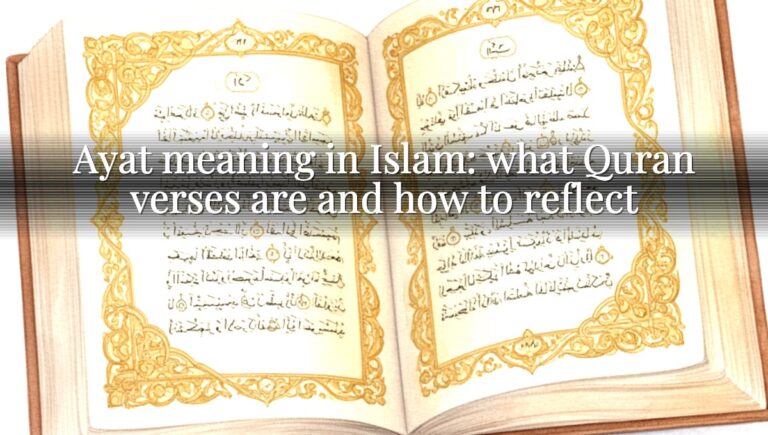
In Arabic, the word “aya” commonly means a sign—something that points beyond itself to truth. In Islamic practice, Muslims often use “aya” to mean a Qur’anic “verse” (an individual unit of revelation). Mainstream Islamic understanding is that each aya is not random text; it is a message from Allah meant to guide hearts and minds. That’s why the Qur’an repeatedly invites people to ponder and reflect rather than treat it like ordinary literature.
One reason this matters is that knowledge and understanding are ultimately gifts. When Allah teaches Adam “the names,” it highlights that real comprehension comes from Allah, not only from human effort. So when you read ayat, you can approach them with effort—and also with humility, asking Allah for clarity.
At the same time, sincerity shapes the impact of Qur’anic guidance. The Qur’an reminds believers that wherever they turn, there is the Face of Allah. Practically, this means engaging the Qur’an isn’t only about location or language skills; it’s about turning sincerely toward Allah with intention.
So, aya as a sign in Islam means: the verse is a communication that invites faith, reflection, and transformation. It’s both information and a nudge—toward the truth Allah reveals.
2) Respectful reading: reflection, not contradiction, not assumption
Many Muslims find it helpful to remember three Qur’anic principles for reading ayat.
First, reflect. The Qur’an explicitly asks people whether they do not reflect on it, and it states that if it were from other than Allah, it would contain much contradiction. This doesn’t mean every reader instantly understands everything—but it does mean the Qur’an’s meanings are coherent and purposeful. Reflection, according to mainstream Islamic teaching, is part of worship.
Second, be careful about interpretation. The Qur’an describes verses that are “precise” as the foundation and others that are “unspecific.” It also notes that no one knows the true interpretation except Allah. Importantly, it then praises those firm in knowledge who believe that all of it is from their Lord. For many Muslims, this becomes a guiding ethic: we can learn and study, but we should avoid pretending to possess certainty in matters the Qur’an assigns to Allah’s ultimate knowledge.
Third, avoid acting on assumption. The Qur’an warns that people follow not except assumption and that assumption avails not against the truth at all. Applied to everyday life: don’t rush to build strong conclusions about what an aya “means for you” if you don’t have sound understanding.
Altogether, the Qur’anic method is balanced: bold reflection, humble learning, and restraint from guessing. That balance helps the aya meaning in Islam become lived guidance rather than vague ideas.
3) Why believers respond: hearing and obeying
Understanding the Qur’an is not only intellectual; it is also behavioral. The Qur’an describes the Messenger and the believers as those who believe in what was revealed from their Lord, and then says their response is to hear and obey—seeking forgiveness and recognizing that the destination is with Allah. This shapes how many Muslims interpret “aya meaning in Islam” in practice: each aya calls for a response.
That response can look different across life stages and knowledge levels. Sometimes it’s gratitude; sometimes it’s repentance; sometimes it’s changing a habit that contradicts the Qur’an’s moral direction. Even when a person doesn’t immediately grasp every detail, the Qur’anic stance encourages respectful submission and gradual growth.
The Qur’an also addresses confusion directly. It states that Allah can abrogate a verse or cause it to be forgotten except that He brings forth what is better or similar. Many scholars explain that Allah’s wisdom governs any shifts in guidance—so believers are urged not to treat the Qur’an as inconsistent, but to trust the system of revelation as a whole.
Finally, the Qur’an’s uniqueness reinforces trust. It challenges people—human beings and jinn—to produce the like of it, even if they help one another. For many Muslims, this stands as a reminder: the ayat are weighty because the Qur’an itself is miraculous and protected in its meaning.
So when you encounter an aya, the goal is not only to decode language, but to let it shape faith and conduct—hearing and obeying with sincere effort.
Practical ways to benefit from Qur’anic ayat
Here are grounded, everyday steps that many Muslims use when learning from Qur’anic ayat (and which can also help respectful non-Muslims).
1) Read with intention. Begin by turning your heart toward Allah, remembering that sincerity matters wherever you are. Even a short reading can be “worship” when paired with humility.
2) Look for the aya’s role in guidance. Ask: What does this sign invite me to believe, feel, or do? The Qur’an’s repeated ethic of hearing and obeying suggests that ayat are meant to produce change.
3) Reflect, then pause. The Qur’an encourages reflection, but it also teaches restraint about uncertain interpretation. So, spend time pondering the clear message first. If you’re unsure about the deeper layers, don’t fill the gap with assumption.
4) Use a simple learning rhythm. For example: read the aya, note any obvious moral or spiritual takeaway, and write one question you can later research with reliable scholarship.
5) Let knowledge be a gift. Since Allah is the One who teaches and grants understanding, make du‘a for comprehension. This prevents reading from becoming dry analysis.
6) Guard your conclusions. The Qur’an warns against following assumption. If you feel confident that an aya means something personal, double-check your understanding—especially before acting publicly or making strong claims.
By practicing these steps, meaning of Quranic ayat becomes more than definition. It becomes a path: reading with reverence, reflecting with balance, and responding with sincere effort.
Frequently Asked Questions
What an aya means in Islam—does it only mean a Qur’anic verse?
In Islam, “aya” most often refers to a Qur’anic verse—an individual unit of revelation. More broadly, the word carries the sense of a divine sign. So Muslims understand ayat as messages from Allah that guide faith and action, inviting reflection rather than mere memorization.
How Muslims understand ayah in the Qur’an when meanings feel unclear?
Mainstream Islamic teaching generally encourages believers to distinguish between what is clear and what is not fully understood. The Qur’an itself highlights that true interpretation belongs to Allah. Many scholars advise learning the clear meanings first, then approaching deeper questions through study and humility.
Is it correct to interpret an aya for “personal meaning” quickly?
It can be helpful to draw lessons for your life, but the Qur’an warns against acting on assumption without knowledge. Many Muslims respond by reflecting on clear guidance, seeking learning when unsure, and avoiding overconfident interpretations—especially for claims that affect worship or major decisions.
How does the idea of aya as a sign in Islam affect daily practice?
When you treat ayat as signs, your daily practice shifts from “reading to finish” to “reading to respond.” Many believers ask: What does this sign call me to believe, improve, or remember? This connects Qur’anic reflection with sincerity, accountability, and gradual spiritual growth.
Key Takeaway: The aya meaning in islam points to Qur’anic verses as divine signs—meant for reflection, sincere belief, and a responsive change in life.
This article offers general information for educational purposes
and reflects mainstream Islamic teaching. It is not a religious ruling (fatwa). For guidance on
your specific situation, consult a qualified local scholar or imam.