Deciphering the Arabic Alphabet with Fatha: A Beginner’s Guide
Arabic, a language rich in history and culture, presents a unique writing system that differs significantly from the familiar alphabets of English and other Western languages. Understanding the role of vowels in Arabic is crucial for accurate pronunciation and comprehension. This article delves into the concept of the Fatha, a fundamental vowel diacritic, explaining how it interacts with the Arabic alphabet to create a nuanced and precise system of sound.
Unlike English, where vowels are essential components of the alphabet, the Arabic writing system primarily uses consonants. Vowels, in Arabic, are represented by diacritical marks, small symbols placed above or below the consonants. These marks, known as harakat, are crucial for distinguishing between words with similar consonant structures. Understanding these diacritical marks is fundamental to mastering Arabic pronunciation. The system is designed to allow for the flexibility of various contextual pronunciations and the precision of the written word. While many sources may not include them in standard text, these marks are essential for comprehension, particularly for learners.
Introducing Fatha: The Short “A” Sound
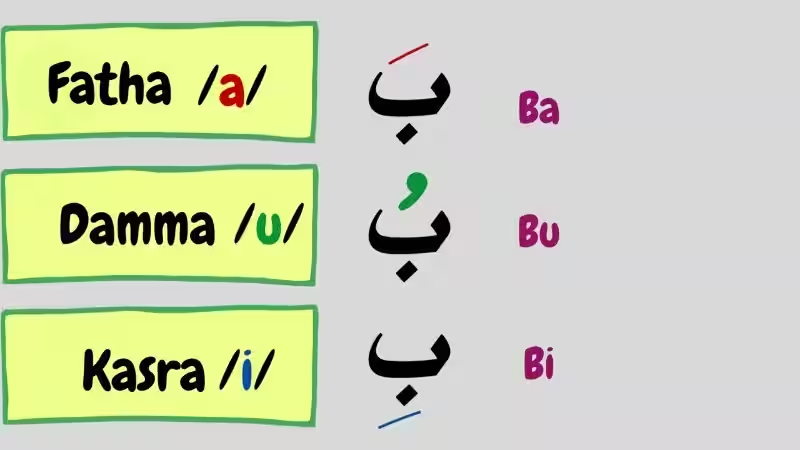
The Fatha (فَتْحَة) is one of the three primary vowels in the Arabic script. Its visual representation is a small, slanted line or tick placed above a consonant. This simple mark transforms the consonant’s pronunciation. The sound produced by Fatha is often described as a short “a” sound, similar to the “a” in the English word “cat.” Alternatively, a short “u” sound, like in “cup,” is sometimes used as an approximation, but be aware that this isn’t the precise equivalent. The key is recognizing it as a specific short vowel sound, not merely a substitution. Learning to hear the subtle difference is key to proper pronunciation.
To understand the practical application of Fatha, let’s examine how it changes the meaning of words. Consider the Arabic letter ب (B). Adding Fatha transforms it into بَ (ba). This subtle change differentiates it from, for instance, بُ (bu), produced by a different harakat (Damma), or بِ (bi), created by Kasra. This simple example illustrates the importance of mastering these variations to communicate effectively. This is an essential concept. The crucial point is that the same letter with different vowels creates distinct words with completely different meanings.
Long Vowels and the Aleph
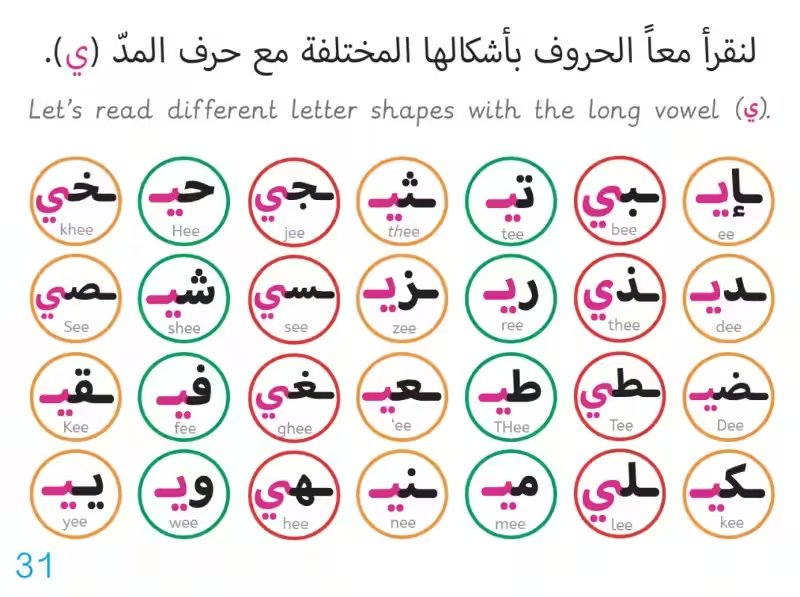
The Arabic language also employs long vowels. The letter Aleph (أ) plays a unique role in this context. It doesn’t represent a consonant sound like other letters but acts as a marker for a long “a” sound. Crucially, the letter Aleph is always accompanied by a Fatha to fully denote the long vowel. This ensures consistency in the vocalization system.
Practical Exercises to Master Fatha
Mastering Fatha requires consistent practice. Here are some exercises to solidify your understanding:
Auditory Recognition: Listen to Arabic words pronounced with Fatha and identify the instances where it occurs. This will help you develop an ear for the sound. Focus on identifying the sound.
Visual Identification: Look at written words and identify the letters marked with Fatha. Count the occurrences of Fatha in short passages.
Writing Practice: Write out words and add the correct Fatha markings above the appropriate consonants. This hands-on approach is critical. Practice with both simple and complex words.
Interactive Learning Tools: Utilize online resources with interactive exercises that allow you to practice applying Fatha, Damma, and Kasra.
Understanding the Distinction between Fatha and Other Vowels
While Fatha creates a short “a” sound, Damma (ضَمَّة) produces a short “u” sound, and Kasra (كَسْرَة) creates a short “i” sound. These three vowels are fundamentally different and must be distinguished. Incorrect application will alter the meaning drastically. Practicing with example words demonstrating each vowel’s unique application will help you differentiate them.
Beyond the Basics: Integrating Fatha with Other Arabic Concepts
Understanding Fatha is just the first step in grasping the intricacies of the Arabic alphabet. The next steps involve learning further diacritical marks and the intricate rules of Arabic grammar. This knowledge will build upon foundational understanding. Further study may involve connecting this knowledge to cultural and linguistic contexts.
The Arabic alphabet with Fatha, at first glance, might seem complex. However, with consistent practice, these concepts become increasingly intuitive. The key lies in understanding the precise role of Fatha in shaping pronunciation and meaning. As you continue your learning journey, remember that patience and dedication are key to mastering the nuances of the Arabic language. Remember that the system is designed for precision, and mastering each part will lead to a richer comprehension of the language.
Arabic Fatha FAQ
This FAQ section addresses common questions about the Arabic vowel “Fatha.”
What is the “Fatha” vowel?
The “Fatha” (فَتْحَة) is a short vowel sound in Arabic. It’s a diacritical mark, not a letter, placed above a consonant to indicate a short “a” sound (like the “a” in “cat”). While Arabic predominantly uses consonants, these diacritical marks, or harakat, are crucial for distinguishing words and conveying meaning. Though often described as a short “u” as in “cup,” the primary sound is akin to the “a” in “cat.”
How is “Fatha” different from other Arabic vowels?
“Fatha” is one of three fundamental short vowels in Arabic. It is distinct from “Damma” (ضَمَّة), which creates a “u” sound (as in “put”), and “Kasra” (كَسْرَة), which produces an “i” sound (as in “sit”). Each vowel’s distinct placement and shape above or below the consonant profoundly alters pronunciation and meaning. For example, the letter “ب” (B) with Fatha is “بَ” (ba), with Damma is “بُ” (bu), and with Kasra is “بِ” (bi). These variations are essential to understanding Arabic.
Why aren’t vowels always written in standard Arabic text?
Standard Arabic writing typically omits vowels. Vowels are included in specialized contexts, such as children’s books, religious texts, and poetry, to aid in pronunciation. However, omitting vowels is typical for adult learners, as it encourages the learner to focus on understanding the grammar and underlying consonant structure before fluent reading without explicit markings.
What is the relationship between “Fatha” and long vowels?
The “Fatha” vowel has a corresponding long vowel form. The letter “Aleph” (أ) modifies the “Fatha” to create a long vowel. “Aleph” is not a consonant but acts as a long vowel character, meaning it always needs a “Fatha” to be pronounced. This one-to-one correspondence is vital for understanding the structure of Arabic vowels. For example, the short “a” sound represented by “Fatha” becomes a long “a” sound when combined with “Aleph”.
How do I practice using “Fatha”?
Practicing with examples is crucial. Many resources, like the Iqraa book, provide examples of words with “Fatha” and exercises to reinforce understanding. Writing out words and adding the correct “Fatha” markings is an excellent way to develop a practical understanding of the system. Auditory exercises can help you hear the difference in pronunciation, too. Remember, for a long “a” sound, the letter “Aleph” is used.