How to Say “My Friend” in Arabic: A Cultural Exploration
Navigating the diverse tapestry of human connection often involves understanding not just the literal translations, but also the nuances of expression. For a ship’s officer in the Suez Canal, the frequent use of “my friend” by Egyptians, even in tense situations, sparks a curiosity about the cultural implications. This begs the crucial question: how can we truly understand the concept of friendship in Arabic? Beyond a simple translation, what does it mean for a person to call someone “my friend” in this context?
While “my friend” is a straightforward concept in English, translating it directly into another language may not always convey the same meaning. The Arabic equivalent, like many linguistic expressions, is not a single precise word, but rather a phrase or even a subtle set of expressions that capture the context and intention. To delve deeper into the cultural understanding of friendship, we need to explore different scenarios and expressions. This exploration is more than just finding a translation; it’s about immersion in the cultural context.
Understanding the context is key. Is the speaker referring to a close confidant, a casual acquaintance, or perhaps someone they respect but don’t know intimately? The Arabic language, rich in its expressive capacity, likely offers distinct ways to convey these subtle variations in meaning. This necessitates a deeper understanding of the cultural norms and social dynamics within Egyptian society.
Exploring Variations and Contexts
The term “my friend” in Arabic likely has several counterparts, each carrying a specific weight and connotation. Consider these possible expressions:
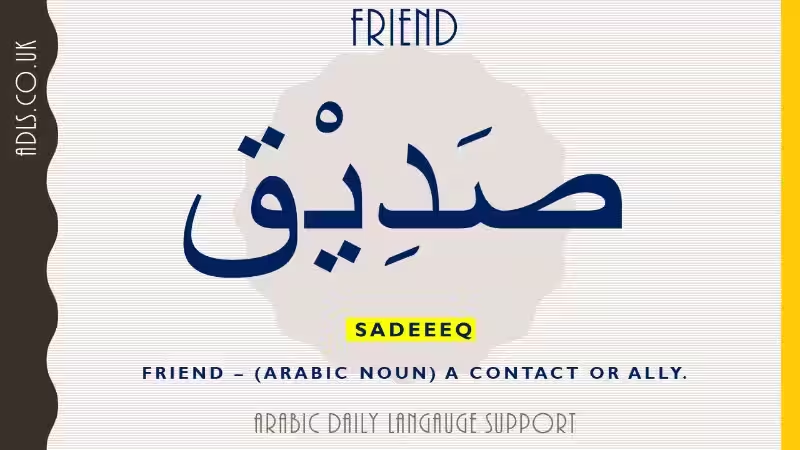
صديقي (Ṣadiqī): This is a common and widely understood way to say “my friend” in modern Arabic. It’s suitable for close friends and often carries a sense of trust and camaraderie.
رفيقي (Rawfīqī): This term implies a companion, a fellow traveler, or someone with whom you share an activity. It suggests a more casual, less emotionally intense friendship.
أخِي (ʾaḫī): Literally translating to “my brother,” this expression can be used to show deep respect and closeness, often implying a bond of trust and support. Within specific cultural contexts, it carries significant weight.
زميلي (Zamīlī): This term, translating to “my colleague,” is appropriate for friends formed through shared work or academic experiences.
شخصاً أعرفه (Shakhṣan aʿrifa): This more literal approach, meaning “a person I know,” can be used more generally. Its use might depend on the specific context of the relationship.
These are merely a few possibilities, and the most appropriate choice would depend on the specific relationship and the situation. It is essential to consider the cultural context to ensure the most accurate and effective communication.
Deciphering the Cultural Significance
Beyond the literal translation, understanding the cultural significance of friendship in Arabic-speaking societies is crucial. In Egypt, for example, social interaction and community ties are very important. Thus, even seemingly casual relationships can be imbued with respect and mutual support.
How the title’s phrase is used in context:
A ship’s officer, navigating the complexities of the Suez Canal, will undoubtedly encounter different interpersonal dynamics. It’s important to remember that “My friend,” in this context, might not carry the same emotional weight as it does in a Western culture. The term might be used as a sign of respect, a commonality, or even a necessary formality.
Additional Factors to Consider:
Formal vs. Informal: Just like in English, Arabic has formal and informal ways to address friends. This must be considered to ensure proper etiquette.
Regional Variations: Arabic dialects vary significantly across the region. What might be acceptable in one part of the Middle East might not be in another.
Social Dynamics: The context of the interaction plays a role. A casual conversation at a market will likely differ from a discussion on a professional level.
By considering factors like the formality of the situation, the regional dialect, and the cultural understanding of friendship, you can better understand how to use these phrases naturally. You’ll be able to better navigate social interactions and appreciate the cultural richness of the Arabic language.
Expanding Linguistic Exploration
The concept of “my friend” extends beyond simple translation. Using a comprehensive online tool or a multilingual dictionary, users can explore related concepts, such as:
Synonyms: Finding alternative ways to express the concept of friendship in Arabic.
Antonyms: Exploring the opposite of friendship, such as rivalry or animosity.
Grammatical forms: Understanding how the word changes to fit different contexts, tenses, and numbers.
Word origins: Delving into the historical and cultural evolution of the concept of friendship in Arabic.
Example sentences: Seeing how the phrases are used in everyday conversations.
By exploring these linguistic aspects, one gains a deeper appreciation for the nuances of communication and the cultural underpinnings of different languages.
Learning how to express the concept of “my friend” in Arabic is more than merely finding a translation. It’s about understanding the cultural context, considering the formality of the situation, and recognizing the varied ways in which friendship is expressed in different Arabic dialects and across various social settings. By using comprehensive multilingual tools and resources, one can move beyond simple translations to a deeper understanding of the profound cultural significance of this fundamental human connection.
How do you say “My Friend” in Arabic?
This section provides answers to common questions regarding translating “My Friend” into Arabic, along with related linguistic information.
What are the common ways to say “My Friend” in Arabic?
There isn’t one single perfect equivalent to “My Friend” in Arabic. The best translation depends heavily on the context and the nuance of the relationship. Several phrases can be used, each with slightly different connotations:
صديقي (Ṣadīqī): This is a common and versatile way to say “my friend,” suitable for most situations. It’s a straightforward translation and generally implies a close and friendly relationship.
رفيقي (Rawfīqī): This can also translate as “my companion” or “my friend,” often suggesting someone you spend time with or travel with. It carries a connotation of shared experience and can be used for both close and less intimate relationships.
أختي (Ukhti): While literally translating to “my sister,” this term can be used affectionately to refer to a close friend, especially a female friend.
أخي (Akhi): The male equivalent of “Ukhti,” this can be used affectionately with a male friend.
زميلي (Zamīlī): This translates to “my colleague” or “my classmate” and is used when referring to a friend in a professional or academic context.
What are the differences in usage between the different Arabic phrases?
The choice of translation depends on the specific context and the relationship. “Ṣadīqī” is generally the most neutral and widely applicable. “Rawfīqī” hints at shared activities, “Ukhti” and “Akhi” express a close affection, and “Zamīlī” focuses on a shared environment. Understanding the context is crucial for choosing the appropriate translation.
Are there any regional or cultural variations?
Arabic is a diverse language with many dialects. While the core words might remain similar, the specific phrasing and connotations can vary between different regions. For example, a phrase used in Egypt might differ slightly from one used in Saudi Arabia.
Can you provide example sentences using these phrases?
صديقي ذهب إلى السينما. (Ṣadīqī ḏahaba ilā al-sinimā.) My friend went to the cinema.
رفيقي يسافر معي. (Rawfīqī yasāfir maʿī.) My companion is travelling with me.
أختي تدرس في الجامعة. (Ukhti tadrus fī al-jāmiʿa.) My sister is studying at the university. (can be used for a close female friend)
Are there any other nuances or subtleties to consider?
The concept of friendship itself can vary across cultures. Arabic culture might emphasize different aspects of friendship, like shared family ties or community connections, than what might be emphasized in other cultures. The use of these phrases should reflect this cultural nuance.
What resources are available to further explore the concept of friendship in Arabic?
This FAQ provides a starting point for understanding how to say “my friend” in Arabic. Additional resources, such as Arabic language learning apps, dictionaries, and cultural websites, can offer deeper insights into the nuances of the language and its cultural contexts.