Deciphering the Best Arabic Dialect to Learn: A Guide for Aspiring Linguists
The question of which Arabic dialect is easiest and most useful, particularly for a learner already fluent in Modern Standard Arabic (MSA), highlights the rich tapestry of the Arabic language. While MSA acts as a unifying standard, it’s rarely used in everyday conversation. The vast array of colloquial dialects, each with its own unique characteristics, present a fascinating, yet daunting, linguistic landscape. This article aims to navigate this complexity, offering a framework to make informed choices about your Arabic dialect learning journey.
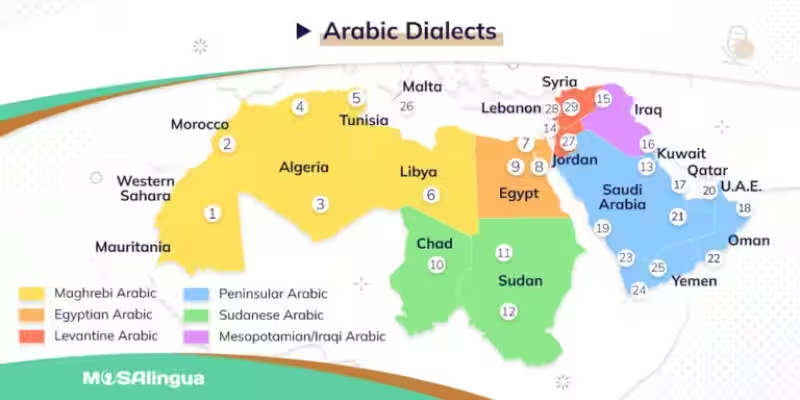
Arabic’s diversity extends far beyond the recognizable standard. Each dialect possesses its own set of vocabulary, pronunciation rules, and grammatical nuances. This variation often leads to significant differences in mutual intelligibility. Imagine trying to understand someone from Cairo speaking Egyptian Arabic if you only know Gulf Arabic! It’s a testament to the linguistic richness of Arabic, but also a challenge for learners. This inherent complexity means that there’s no single “best” dialect – the ideal choice depends entirely on your individual goals and circumstances.
A learner’s goal – to grasp multiple dialects with the understanding of a single dialect – can be ambitious but not impossible. It necessitates understanding the interconnections between dialects, recognizing the common roots while appreciating the significant variations. There are strategies to maximize your learning and understanding across different dialects, though it requires understanding the linguistic landscape as a whole. This detailed approach allows the learner to appreciate the diverse cultures that surround the Arabic language.
Factors Influencing Your Choice
Several crucial factors play a role in selecting the “best” dialect to learn. These aren’t mutually exclusive, and often a combination of these factors will help you choose the best path for your needs.
Geographic Focus and Communicative Goals
Your primary communicative goals greatly influence your choice. If you plan to travel extensively to Saudi Arabia, learning the Gulf Arabic dialect may be beneficial. If your career goals lie in Egypt, studying Egyptian Arabic would be strategically advantageous. Understanding the target audience is essential. Are you aiming for broad communicative reach or focused regional interaction? Consider geographic localization when choosing the most appropriate dialect.
Ultimately, your learning experience should align with your goals. Learning a dialect spoken in a specific region can offer quicker results but may limit broader communication. A broader understanding of regional variations and commonalities can improve understanding across different Arabic-speaking regions. Therefore, seeking a dialect that encompasses a significant portion of the Arabic-speaking world, such as Egyptian Arabic, may prove to be more beneficial.
Accessibility of Resources and Learning Style
Learning resources can significantly impact your learning journey. Does the dialect you’re considering have readily available language learning materials, online communities, or tutors? This access to learning materials and community support can make a significant difference in your success. Consider which dialect aligns best with your learning style (e.g., interactive learning apps, language exchange partners) and the availability of resources for that specific dialect.
Imagine a dialect without substantial online support. It may be more difficult and time-consuming without consistent learning resources. The availability of learning materials, tutors, and language exchange partners will significantly impact your learning experience and should be factored into the decision-making process. Therefore, considering the level of community support for the dialect you choose is crucial for a successful learning outcome.
Approaching the Complexity of Arabic Dialects
Learning any Arabic dialect involves confronting significant challenges. You should be prepared to navigate the complexities in pronunciation, vocabulary, and grammar. The transition from MSA to a particular dialect may introduce new challenges. This means understanding the significant differences in vocabulary, pronunciation, and even sentence structure.
The learner must acknowledge the significant variation between dialects. While some dialects may share common roots and grammatical principles, significant differences inevitably arise in vocabulary, pronunciation, and sentence structure. The learner should also prepare for the inherent difficulties in vocabulary as pronunciation and grammar are likely to vary from MSA. Preparing for the nuances of each dialect is important for a smooth learning process.
Finding Your “Best” Arabic Dialect
The concept of a single “best” Arabic dialect is a fallacy. Instead, the goal is to choose a dialect that aligns with your communicative needs and learning style. Thorough research, exploration of resources, and an understanding of the linguistic nuances of Arabic dialects will form the foundation for a successful and fulfilling learning experience. Ultimately, the most effective approach is to choose a dialect with a strong presence in a region that aligns with your communication needs and invest time in understanding its unique features. Be prepared for a journey of linguistic discovery, understanding that the “easiest” dialect is a subjective term.
By focusing on a single dialect as a stepping stone toward more nuanced dialectal understanding, you can begin to appreciate the interconnected nature of dialects. It’s crucial to delve into the sociolinguistic context and regional variations within each dialect. This ensures that you not only learn to communicate but also understand the cultural significance and social implications of the language. The choice is ultimately yours, informed by your motivations, goals, and resources. Don’t be afraid to explore, experiment, and embrace the beauty of Arabic’s linguistic diversity.
FAQ: Choosing the Best Arabic Dialect to Learn
This FAQ addresses the challenge of selecting the “best” Arabic dialect for learners, particularly those already proficient in Modern Standard Arabic (MSA).
What is the “easiest” Arabic dialect to learn?
There isn’t a single “easiest” dialect. The perceived difficulty depends heavily on the learner’s background, learning style, and desired communicative goals. While some dialects might have simpler grammatical structures in certain areas, complexities in pronunciation or vocabulary may arise. Focusing on a single dialect as a gateway to understanding all dialects is an oversimplification, as substantial variation exists.
If I already know MSA, will learning a dialect be easier?
Knowing MSA will provide a foundational understanding of Arabic grammar and structure, potentially accelerating the learning of a dialect. However, dialects often diverge significantly in vocabulary, pronunciation, and even sentence structure. The transition will involve acquiring new skills and adapting to differing linguistic patterns.
What factors should I consider when choosing a dialect?
Several factors influence the best dialect choice, including:
Geographic focus: If you plan to visit or interact with speakers in a specific region, learning the relevant dialect will be more beneficial.
Learning resources: Consider the availability of tutors, language exchange partners, and educational materials for the dialect. A lack of resources can impede progress.
Communicative goals: If understanding a broad range of dialects is a goal, focusing on structural commonalities and differences across various dialects might be a more strategic approach.
Personal learning style: Some learners might find dialects with certain pronunciation patterns or grammatical features more challenging than others.
Is there a dialect that provides a better understanding of other dialects?
No single dialect offers a perfect “gateway” to all others. While some dialects share similarities, significant differences exist. Learning multiple dialects is a worthwhile endeavour but requires acknowledging and embracing the diverse linguistic landscape of Arabic.
Can a single dialect help me communicate with diverse Arabic speakers?
While a specific dialect might allow communication within a particular region, it may not be universally understood across the Arabic-speaking world. Focusing on dialects spoken in major urban centers or countries with large Arabic-speaking populations could provide more broad communicative applicability.
What should I do if the dialect I choose has limited resources?
While limited resources make learning a dialect more challenging, they can also be an opportunity to explore language learning methods beyond readily available materials. Seeking out language exchange partners, online forums, or even creating your own study resources can be effective strategies.
What are the potential benefits of learning a specific Arabic dialect?
Beyond practical communication, learning a dialect opens doors to:
Cultural understanding: Provides insight into the rich history, traditions, and values of the region where the dialect is spoken.
Career opportunities: In specific industries, proficiency in a particular dialect can be a valuable asset.
Personal enrichment: Opportunities for cross-cultural interaction and travel.
What is the best way to approach learning multiple dialects?
A comprehensive understanding of Arabic dialects requires a nuanced approach. Understanding structural commonalities and differences, along with the sociolinguistic context and regional variations, is crucial. Focusing on a single dialect as a stepping stone to broader dialectal understanding is a viable strategy, but it requires sustained effort.